
Finsphere
Issue 32 | Oct 2026  Your Monthly Guide on Global and Local markets from our Business Head’s Desk.

The Inflation Reawakening
Oil price pressures and shifting interest rate expectations reshape the global market outlook, while AI-led growth offers a counterpoint to rising uncertainty.

Dear Clients and Stakeholders,
September 2026 marked a shift from concerns around slowing growth to resurgent inflation and higher-for-longer interest rates. The key driver remained the unresolved Middle East conflict and continued disruptions around the Strait of Hormuz, which pushed Brent crude back above $100 per barrel and reignited energy price driven inflation. Rising inflation in tandem with fairly resilient economic growth in several major economies, led to interest rate hike by central banks across the board while guiding for more to come which in turn led to a sharp rise in bond yields and a repricing of monetary policy expectations.
Global equity markets therefore faced a more challenging environment, with rising bond yields, higher energy costs, and a stronger US dollar weighing on broad market performance. While AI-related technology companies and US equities in general continued to outperform, supported by strong earnings growth and ongoing investments in semiconductors, cloud infrastructure and data centres while market leadership narrowed as investors became increasingly selective.
As we move into October, market focus is likely to remain on the trajectory of oil prices, the evolution of the Middle East conflict and corporate earnings. While resilient economic activity and continued AI-driven investment remain supportive for equities, persistent inflationary pressures, tighter financial conditions, and geopolitical uncertainty are expected to keep market volatility elevated in the near term.
United States
Economic Resilience Persists Despite Emerging Signs of Labour Market Moderation
The US economy remained resilient through September, supported by strong consumer spending, business investment, and improving economic growth. Q2CY26 GDP growth was revised higher to 2.2% from the earlier estimate of 1.5%, reflecting stronger consumer spending, business investment, and government expenditure, with AI-related investments and data centre construction continuing to support activity. Retail sales also rebounded sharply, rising 1.2% in August, the strongest increase in five months, underscoring the resilience of domestic demand despite elevated energy prices and higher borrowing costs.
Inflation and monetary policy remained key areas of focus during the month. Headline inflation held steady at 3.4% in August, while higher gasoline and fuel costs linked to the Middle East conflict continued to exert upward pressure on prices. Producer prices increased 0.4% MoM, driven largely by energy-related costs. However, the core PCE, moderated to 3.0%, indicating some easing in underlying price pressures. Reflecting persistent inflation and resilient economic conditions, the Federal Reserve raised the federal funds rate by 25 bps to 3.75%-4.00%, its first-rate hike since 2023, while signalling that further tightening remains possible if inflation fails to return sustainably to target.

Business activity strengthened considerably during September. The Manufacturing PMI rose to 55.9 from 53.9 in August, its highest level since May 2022, supported by stronger production, new orders, and technology-related demand. The Services PMI increased to 58.7 from 56.5, marking the strongest expansion in more than five years as robust domestic demand boosted business activity and employment. However, industrial production remained unchanged in August as weakness in manufacturing output offset gains in utilities and mining.
Labour market indicators presented a more mixed picture. Initial jobless claims remained near multi-decade lows at 197,000, indicating limited layoffs and continued labour market stability. However, hiring momentum moderated, with non-farm payrolls increasing by just 29,000 in September, well below expectations, while job openings declined to a five-month low of 7.08 million. The unemployment rate rose marginally to 4.2% from 4.1%, although the increase was accompanied by higher labour force participation, suggesting that more workers entered the labour market.
Overall, the US economy remains supported by resilient consumer demand, strong business activity, and robust investment spending. However, sticky inflation, tighter monetary policy, softer hiring trends, and elevated energy prices suggest that the Federal Reserve is likely to maintain a cautious stance as it balances inflation risks against a gradual moderation in economic growth.

Euro Area and UK
Improving Growth Amid Elevated Inflation
In the Euro Area, the economic backdrop remained relatively resilient despite elevated inflation and tighter monetary conditions. The European Central Bank (ECB) raised its key policy rates by 25 bps in September, taking the main refinancing rate to 2.65% and the deposit rate to 2.50%, citing persistent inflationary pressures stemming from the ongoing Middle East conflict. Euro Area GDP growth accelerated to 1.2% YoY in Q2CY26 from 0.6% in Q1, driven by stronger household spending, fixed investment, and a recovery in exports. However, inflation remained elevated, rising to 3.2% in August from 2.9% in July, largely due to a sharp increase in energy prices.
Industrial production declined marginally by 0.1% in July, reflecting weakness in non-durable consumer goods, although capital goods and intermediate goods production showed improvement. On the external front, the Euro Area trade surplus widened to €14.2 billion, the highest in nine months, supported by strong export growth across chemicals and manufactured goods. Business activity also strengthened, with the Manufacturing PMI rising to 52.9, its highest level since May 2022, while the Services PMI improved to 53.0, reflecting stronger domestic and export demand. Meanwhile, the unemployment rate remained stable at 6.4%, highlighting continued labour market resilience despite higher energy costs and tighter financial conditions.
In the United Kingdom, policymakers maintained a cautious stance amid rising inflation and an improving growth backdrop. The Bank of England kept the Bank Rate unchanged at 3.75%, while emphasizing the need to monitor the inflationary impact of elevated energy prices. Economic growth strengthened during the second quarter, with GDP expanding 1.4% YoY compared to 0.8% in Q1, supported by stronger services activity, business investment, and exports. Inflation accelerated further to 3.1% in August from 2.9% in July, driven primarily by higher fuel and housing-related costs.
Industrial production also rebounded, increasing 0.2% in July as higher manufacturing output offset weakness in mining and utilities. On the external front, the UK's trade deficit narrowed to £3.45 billion, supported by rising exports and lower imports. Business activity remained in expansion territory, with the Manufacturing PMI at 51.9, supported by AI-related investments and defence spending, while the Services PMI eased to 51.7 amid softer demand and geopolitical uncertainty. Meanwhile, the unemployment rate remained unchanged at 4.9%, indicating a broadly stable labour market.
Overall, Europe continued to demonstrate resilience through improving growth and business activity, although elevated inflation, higher energy costs, and ongoing geopolitical uncertainties remain key challenges for the region.
Asia
Export Strength Offsets Domestic Demand Headwinds
In China, policymakers maintained a cautious stance as growth remained uneven. The People's Bank of China kept its key lending rates unchanged for a sixteenth consecutive month, prioritizing stability amid ongoing geopolitical uncertainty and weak domestic demand. Inflation edged up to 0.8% in August from 0.5% in July, while producer price inflation accelerated to 3.8%, reflecting higher energy costs. Economic activity remained mixed, with industrial production growth accelerating to 5.2% YoY in August, supported by manufacturing activity, while retail sales slowed to 0.4%, highlighting continued weakness in consumer spending.
Labour market conditions softened further, with the urban unemployment rate rising to 5.3%. On the external front, China's trade surplus widened to $119.1 billion, supported by strong exports of technology-related products despite rising imports. Business activity improved, with the Manufacturing PMI rising to 52.1 and the Services PMI to 51.6, supported by firmer domestic and export demand.
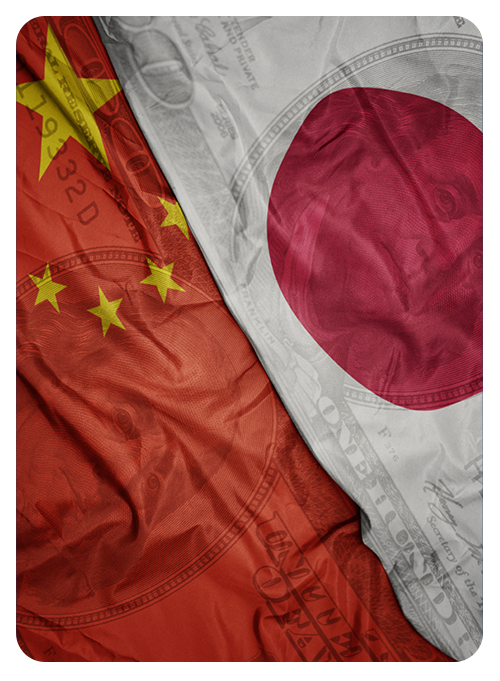
In Japan, policymakers continued their policy normalization efforts as inflationary pressures remained elevated. The Bank of Japan raised its policy rate by 25 bps to 1.25%, taking borrowing costs to their highest level since 1995. Economic growth improved modestly, with Q2CY26 GDP growth revised up to 1.4% annualized, supported by net exports and government spending, although household consumption and capital expenditure remained subdued. Inflation remained at 1.9% in August, while Tokyo core inflation accelerated to 2.7%, signaling rising underlying price pressures. Consumer demand remained relatively resilient, with retail sales increasing 2.7% YoY in August, supported by government measures.
However, industrial production contracted for a second consecutive month, declining 1.7% in August amid weaker demand across key manufacturing sectors. On the external front, Japan's trade deficit widened sharply to JPY 1.1 trillion as imports, particularly energy imports, grew faster than exports. Business activity remained in expansion territory, with the Manufacturing PMI at 54.1 and the Services PMI at 51.6, although both moderated from the previous month. Meanwhile, the unemployment rate edged up to 2.5%, indicating a slight softening in labour market conditions.
Overall, Asia presents a mixed outlook, with China benefiting from strong exports and improving manufacturing activity despite weak domestic demand, while Japan remains supported by resilient business activity and exports, although higher inflation and policy normalization pose risks to growth momentum.

India
Strong Domestic Momentum Amid Rising Inflation
India's economy remained resilient during September, supported by strong industrial activity and robust business momentum despite elevated energy prices. Inflation rose to 4.82% in August from 4.45% in July, driven by higher food and fuel prices, while wholesale inflation accelerated further to 9.92%, reflecting continued cost pressures across fuel, manufacturing, and food categories.
Economic activity strengthened during the month. Industrial production growth accelerated to 8.0% YoY in August, led by robust manufacturing and electricity generation, while infrastructure output grew 4.8%, supported by strong production of cement, steel, and iron ore. Business activity also improved meaningfully, with the Manufacturing PMI rising to 55.1 and the Services PMI surging to 58.1, supported by strong domestic demand, healthy export orders, and improved employment conditions.
Labour market conditions remained healthy, with the unemployment rate easing to 5.0% in August from 5.1% in July, while resilient domestic consumption and financial activity were reflected in strong growth in life insurance premiums. On the external front, India's trade deficit remained broadly stable at $26.9 billion despite higher energy import costs, supported by robust export growth of 25.5% YoY.
Overall, India's growth momentum remains well supported by strong industrial activity, resilient domestic demand, and a robust services sector, although elevated inflation and energy prices continue to pose key risks.
Conclusion
The global economy continues to navigate a challenging environment marked by resilient growth, persistent inflationary pressures, and elevated geopolitical uncertainty. While economic activity has generally remained stronger than expected across major regions, elevated energy prices and ongoing supply-side uncertainties have reignited inflation concerns and complicated the policy outlook. In response, major central banks have maintained a cautious stance, with policymakers emphasizing their commitment to price stability and reinforcing expectations of a higher-for-longer interest rate environment.
Despite these headwinds, economic momentum remains broadly intact. The United States continues to benefit from strong consumer demand, robust business activity, and ongoing investment in AI-related sectors, while Europe has shown resilience through improving growth and business activity despite persistent inflation pressures. In Asia, growth dynamics remain mixed, with China supported by strong exports and manufacturing activity despite weak domestic demand, while Japan continues to benefit from resilient business activity and external demand even as policy normalization gains pace. India remains among the fastest-growing major economies, supported by strong industrial activity, resilient domestic demand, and robust services-sector growth. Looking ahead, developments in the Middle East, energy price trends, and evolving monetary policy expectations will remain key determinants of global growth, inflation, and market sentiment.
At Chola Securities, we remain steadfast in our commitment to helping you navigate these complexities with clarity and foresight. As always, we aim to align your investments with evolving opportunities while ensuring resilience against emerging headwinds.
We sincerely thank you, our valued clients and investors for your continued confidence and partnership. Together, we look forward to embracing the challenges and opportunities of the months ahead, ensuring sustained growth and success.