
Finsphere
Issue 23 | January 2026  Your Monthly Guide on Global and Local markets from our Business Head’s Desk.
Closing 2025, Looking Ahead:
Markets reset as growth expectations improve

Dear Clients and Stakeholders,
Indian equity markets concluded the year with mild pressure after navigating a year which was marked by tariff induced volatility and geopolitical uncertainty. The Nifty declined 0.28% in December 2025 following three consecutive months of gains, closing the year with annual gains of 10.5%. However, investor continue to be confident stepping into 2026, amid growing optimism around country's economic growth trajectory, expected resolution on tariff with US and better-than-anticipated earnings from corporate India going forward. With the revamped indirect tax structure (GST 2.0) and earlier announced direct tax rate cuts, domestic consumption is expected spearhead economic growth in India especially amidst an environment of interest rate cuts and benign inflation.
Globally, the year 2025 was largely shaped by President Donald Trump’s hostile tariff stance which took a more constructive turn with resolution to long standing trade negotiations with crucial trading partners such as Japan, South Korea and most importantly China being reached in November. Further, the federal operations have returned to normalcy following the 43-day shutdown which lasted till November 13th.
Against this backdrop, US equity markets experienced elevated volatility through the year. The Dow Jones Industrial Average ended 2025 with gains of 12.97%, while the S&P 500 closed December with annual returns of 16.30%. Despite concerns around an “AI bubble” prompting profit booking, the technology-heavy Nasdaq outperformed, emerging as the best-performing US index with gains of 20.03% for the year.
Investors are facing a fresh surge in geopolitical risk at the start of the new year after the US capture of Venezuelan President Nicolas Maduro. President Trump stated that the US would take control of the oil producing nation, noting at a press conference that the United States would “run the country until such time as we can do a safe, proper and judicious transition,” while not ruling out military intervention. Shortly after the capture, President Trump indicated that American oil companies were prepared to invest billions of dollars to revive Venezuela’s crude oil production, raising expectations that increased supply could help ease global energy prices and support growth.
OECD in its Economic Outlook Report for December highlighted that the global economy was resilient in 2025, despite concerns about a sharper slowdown in the wake of higher trade barriers and significant policy uncertainty. Activity held up primarily due to front-loading of production and trade, strong AI-related investment, and supportive fiscal and monetary policies. However, global GDP growth is projected to ease from 3.2% in 2025 to 2.9% in 2026 with near term activity expected to soften as higher effective tariff rates gradually feed through, weighing on investment and trade, amid persistent geopolitical and policy uncertainty.
United States
Growth resilience amid easing inflation and softening labour conditions
The US economy demonstrated strong momentum in Q3CY25, with GDP expanding at an annualized pace of 4.3%, the fastest in two years and well above both the prior quarter’s 3.8% growth and market expectations. The expansion was broad-based, driven by firm consumer spending, a sharp rebound in exports, and a recovery in government expenditure. On the policy front, the Federal Reserve delivered a widely anticipated 25 bps rate cut in December, taking the policy rate to a range of 3.5%–3.75%, marking the lowest level since 2022.
Industrial production posted modest gains across October and November, rising 0.1% per month with manufacturing output broadly flat. Retail sales, meanwhile, remained largely stagnant in October. Labour market conditions softened further. The unemployment rate climbed to 4.6% in November, the highest since 2021, while broader measures of underemployment rose amid a pickup in involuntary part-time work.

Non-farm payroll growth turned positive, with 64k additions in November, following October’s sharp contraction. The growth was led by health care and construction, though federal employment continued to decline. Job openings remained largely stable in October, with gains concentrated in trade and healthcare offset by declines in professional services and the public sector. Externally, the US trade deficit narrowed sharply in September to $52.8 billion – the lowest level since mid-2020 - supported by strong export growth of 3% while imports expanded at a slower 0.6%.
Meanwhile, housing activity gained traction. Pending home sales recorded a fourth consecutive monthly increase at 3.3% while existing home sales rose to a nine-month high, rising 0.5%, despite slowing price appreciation and tightening inventories. Home prices edged higher at 0.4% on a monthly basis, though year-on-year gains remained modest.

Eurozone & UK
Subdued growth amid easing inflation and labour market slack
In the Euro Area, the ECB maintained policy rates for a fourth consecutive meeting, with the main refinancing rate remaining at 2.15% and the deposit facility rate holding at 2.0%. Inflation moderated further, with headline CPI revised down to 2.1% in November and core inflation holding steady at 2.4%. Industrial activity showed a notable improvement, with industrial production rising 0.8% month-on-month in October - the strongest increase since May - and annual growth accelerating to a five-month high.
The recovery was broad based across consumer, capital, and intermediate goods. External trade strengthened meaningfully, as the Eurozone trade surplus widened sharply to €18.4 billion in October 2025. Exports for the month rose 1.0% supported by stronger shipments of machinery and vehicles while imports declined 3.6%. The UK economy continued to face a fragile growth backdrop. GDP growth slowed in Q3CY25 to 1.3% - the slowest annual growth in a year as household consumption, government spending, and investment all moderated.
Inflation slowed to 3.2% in November, undershooting both market and central bank expectations, with broad-based moderation across food, transport, housing, and services. Labour market conditions weakened further, with unemployment rising to 5.1% and employment declining in the three months to October 2025. Against this backdrop, the Bank of England cut its policy rate by 25 bps to 3.75%, marking its first reduction in four months, following clearer evidence of easing inflation and labour-market slack.
Further, industrial production rebounded sharply rising 1.1% month on month in October following a steep contraction in September. Retail activity remained subdued, with sales volumes declining for a second straight month at 0.1% month-on-month in November despite seasonal discounting. On the trade front, the trade deficit widened to £4.82 billion in October 2025, marking the largest gap since February. Exports fell by 0.3% month on month, languishing at four-month lows while imports rose 1.7%.
Overall, both the Euro Area and UK are battling slowdown in economic growth amid growing labour market slack indicating both European Central Bank and Bank of England may increasingly be inclined towards a dovish stance to stimulate growth.
Asia
Slowing momentum in China; BoJ delivers decisive rate hike amid complex macro environment
China’s industrial production growth eased to 4.8% in November, the weakest since mid-2024, reflecting softer manufacturing output. Retail sales rose 1.3% year-on-year for November, posting their slowest growth since late 2022, with broad-based weakness across categories despite ongoing policy support. Inflation picked up modestly in November, with CPI rising to 0.7% and core inflation holding at a 20-month high, suggesting easing of deflationary pressure but still subdued domestic demand. Labour market conditions remained stable, with the urban unemployment rate holding at 5.1%. Monetary policy remained unchanged, as the PBoC kept benchmark lending rates at record lows, signaling continued policy support to stimulate a revival in economic activity. On the trade front, surplus widened to USD 111.68 billion – the largest level since June, supported by a rebound in exports (+5.9% year-on-year) amid easing trade tensions with the US.
Japan’s macro backdrop presented a more complex mix. Inflation remained elevated, with headline CPI edging down to 2.9% and producer prices rising 2.7%, indicating persistent upstream cost pressures. The Bank of Japan raised policy rates to 0.75%, taking another landmark step in ending decades of huge monetary support and near-zero borrowing costs. At the same time, industrial production contracted 2.6% month-on-month in November, driven by declines in autos, electronics and fabricated metals.
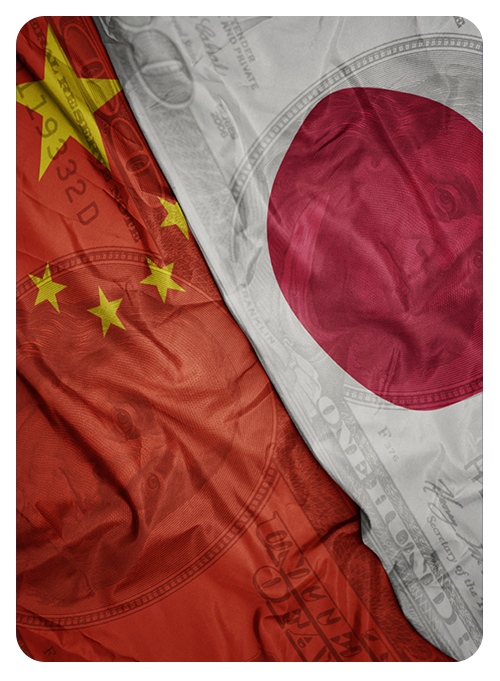
Retail sales continued to grow in November with a gain of 1% year-on-year in November, supported by household spending on essentials, wage gains, and tourism. Labour market conditions were stable, with unemployment holding at 2.6%. On the trade front, Japan recorded its first trade surplus since June at JPY 322.2 billion for November, supported by strong export growth (+6.1% year-on-year) while imports (+1.3% year-on-year) grew at a slower pace.
Japan and China are both experiencing an economic slowdown. In China, strong policy measures have helped sustain growth despite early indications of weakening momentum. Japan, however, faces a more complicated outlook, as heightened inflation coupled with economic contraction places the Bank of Japan in a challenging position.

India’s Economic Pulse:
Domestic resilience continues, US tariff resolution in sight
India’s macro indicators reflected resilient domestic momentum. Industrial production rebounded sharply in November, expanding 6.7% year-on-year - the fastest pace since October 2023 - led by a strong acceleration in manufacturing and a recovery in mining activity. Infrastructure output also returned to growth, rising 1.8% in November after a brief contraction in the previous month. Growth was driven by robust cement and steel production, though energy-related segments such as crude oil and natural gas extended their contraction streaks. On the trade front, the trade deficit narrowed sharply to its lowest level in five months at USD 24.53 billion, as exports surged 19.37% despite US tariffs, supported by government incentives. On the other hand, imports declined 1.88% on a sharp fall in gold imports and oil & coal shipments.
Inflation remained exceptionally benign. Headline CPI, in November, edged up modestly to 0.71% but stayed well below the RBI’s lower tolerance band of 2% for a third consecutive month, supported by continued deflation in food prices and subdued goods inflation following GST rationalization.
Wholesale prices fell 0.32% in October, marking a second straight month of deflation, though the pace of decline moderated. Labour market conditions improved materially, with unemployment falling to 4.7%, the lowest level in several years, alongside rising labour force participation and employment rates.
Overall, India’s macroeconomic landscape reflects an optimistic trajectory with underlying industrial strength, robust domestic demand, and supportive policy measures - such as the introduction of GST 2.0, direct tax rate cuts, interest rate cuts along with a pro-growth stance of the RBI - anchoring the economy. Further, the impending resolution on US tariffs expected to be concluded within the first half of 2026 if not the first quarter is expected to add to robust domestic demand.
Conclusion
As we step into the new year, global markets continue to be shaped by evolving diplomatic trade relations amid persistent macro uncertainty brought forward by US tariffs. The US faces structural headwinds from tariffs while a cooling labor market keep markets on edge. The Eurozone and UK are balancing near term inflation amid soft industrial activity and labor market slack, while Japan and China navigate a slowdown in economic activity.
In contrast, India stands out for its relative stability. Strong domestic demand, supportive fiscal and monetary policies and moderating inflation provide a resilient foundation for growth. As global uncertainties persist, India’s macroeconomic tailwinds and steady policy approach position the country to sustain momentum.
At Chola Securities, we remain steadfast in our commitment to helping you navigate these complexities with clarity and foresight. As always, we aim to align your investments with evolving opportunities while ensuring resilience against emerging headwinds.
We sincerely thank you—our valued clients and investors—for your continued confidence and partnership. Together, we look forward to embracing the challenges and opportunities of the months ahead, ensuring sustained growth and success.
Warm Regards,
N Senthilkumarh
President, Chola Securities